


In the final installment of her special guest series “Learning to Read Around the World,” former Kindergarten teacher and world traveler Launa Hall reflects on a visit to a U.K. primary school that felt unexpectedly like home. In Bradford in West Yorkshire, she finds familiar challenges, including linguistic diversity, evolving reading mandates, and the intricacies of the English language, alongside the steady, relationship-driven work of dedicated educators.
We’re so grateful to Launa for sharing her amazing adventures and insights with Book Life. Her journey with us closes with a clear and reassuring reminder that, across classrooms and continents, children ARE learning to read — with decoding as the foundation of strong, well-rounded literacy instruction. Thanks to Launa’s global perspective on what it takes to teach children to read, I hope that like me, you’ve come to see more clearly the practices that matter most.
Learning to Read in the United Kingdom by Launa Hall

I felt an odd sense of homecoming at St. Steven’s Primary, a neighborhood school in Bradford, U.K.
Maybe it was simply because they were speaking English, a first for me in this series of international school visits. These teachers and I share the difficulties of teaching young children to decode the very deep orthography of English, a process that can take up to three years. In contrast, learning to read more phonetic languages (such as Italian) can take about three months.
It wasn’t only that. I was on familiar ground when talking with teachers or visiting schools in Bulgaria, Greece, Morocco, Italy, Vietnam, South Korea, Finland, Turkiye, Romania, Japan, Indonesia, Laos, and the tiny pacific island of Rapa Nui. So completely different, these places. Yet in each, teachers work diligently through challenges both small and huge, just like my colleagues in the U.S. No matter where I was, the sight of little kids with their heads bent over the graphemes of their language, doing the work to become literate citizens of their communities, reminded me of the children in my classroom in Virginia before I began these travels.
But yes, the school in Bradford, a mid-sized northern city about a four-hour train ride from London, and the last for this series, felt even more familiar. Was it the robust security system at the front office? In many places in the world, I met my hosting teacher or administrator on the playground, or in their second-floor classroom, or wherever. In some places I was asked to sign a visitors’ log or wait for an escort, but only in Bradford was my passport scrutinized for a positive ID check. After I’d put on my visitor badge, I was escorted through multiple locked gates and doors. Just like my school, I thought; most public school teachers in the U.S. would recognize this level of security.
Then I met my host and principal of the school, Paul Urry, a big reason I felt at home. He generously showed me around and answered questions, which felt all the more generous when I learned they were at the hectic end of a term. I learned about some of the challenges his school is facing. Children at his school speak 41 languages. Their families have fluctuating refugee status, home stability, and food security, so he and his staff are both educating students and connecting families with community services. Their economically depressed neighborhood struggles; Paul told me about his routine of walking the playground perimeter in the early morning, looking for any drug paraphernalia left over from the night before.
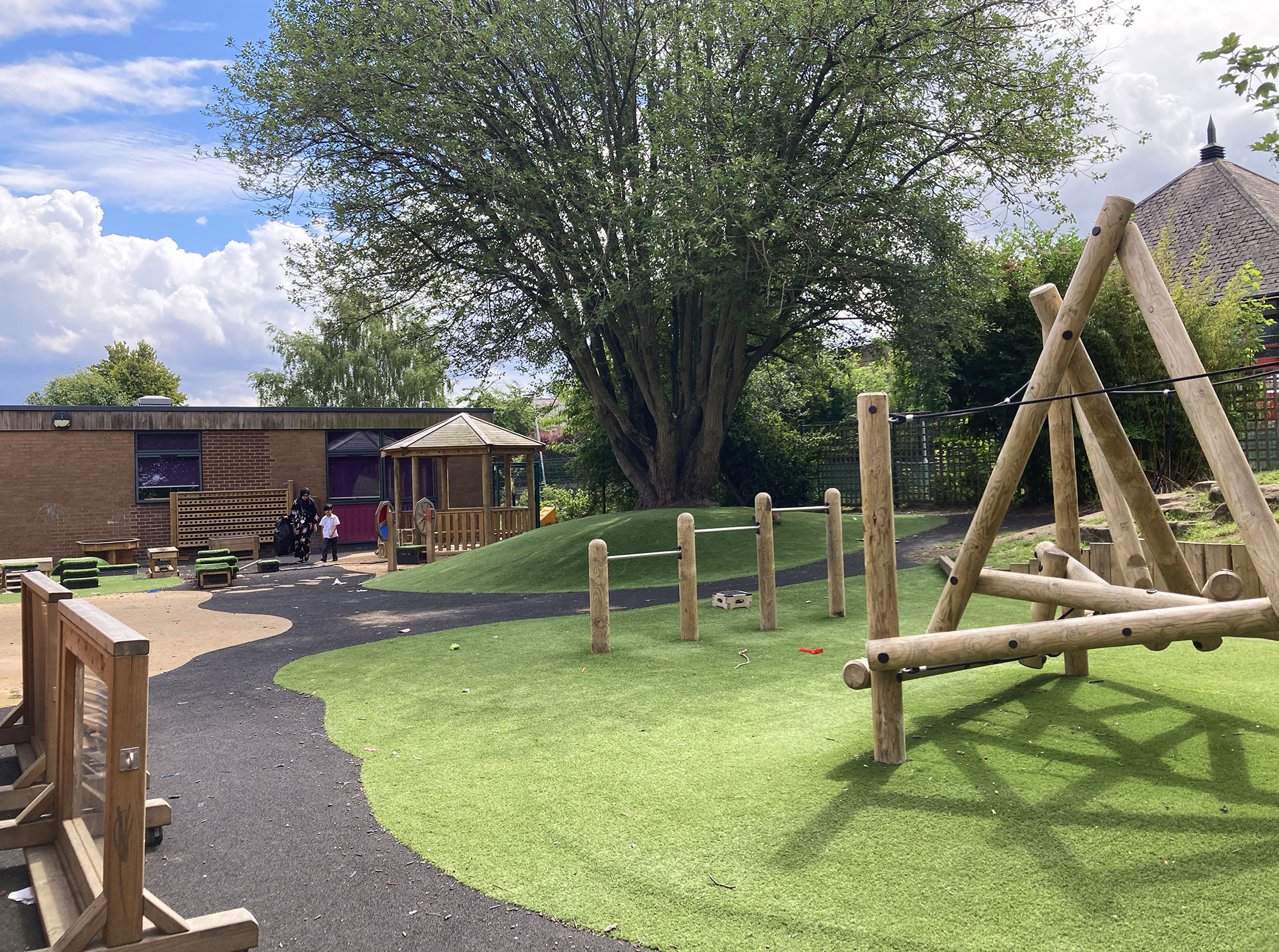
A lovely day on the St. Steven’s playground, Bradford, U.K.
Yet Paul’s defiant buoyancy in the face of difficulties and his devotion to supporting his staff would hearten even the most discouraged. He’s an enthusiastic champion of relationship-building as the core of a good school, a leader focused on the big picture but also attentive to details. He pointed out the neutral colors on the walls (“good for concentration!”), the wall art by a local artist, and the kid-sized, ergonomic furniture. Paul proudly told me that he involved the students in choosing the chairs.
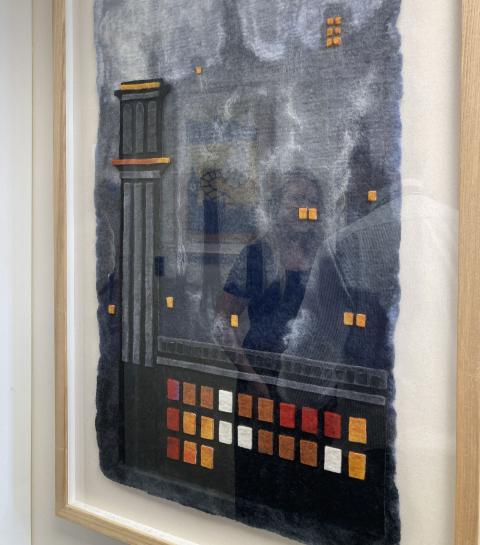
Two educators in conversation, as reflected in artwork in felt, depicting a Bradford landmark.
And students lit up when they saw him in the hallway. He seemed to know the name of each child we passed. One boy, working hard to communicate in his newly acquired English, stopped by to make sure his teatime with the principal, an award he’d earned, was still on for that afternoon.
Yes, it was still on. Everything seemed to be on, full sail ahead. I’m sure Paul works too many hours. If all this sounds very familiar to teachers and administrators in North America, it does to me, too: that feeling of a job as big as humanity crammed into a typical school day, in an ordinary school building. The challenges faced in Bradford were strikingly similar to those faced across the Atlantic.
But as we spoke about teaching kids to read, I realized the familiarity might be English after all. That is, teaching the reading of English. Here, I heard worries about reading instruction that I hadn’t heard since I’d left home.
Paul, as well as other British educators I spoke with, sighed while talking about it. They’ve seen a lot of reading strategies, curricula, opinions of experts, and governmental guidance come and go in their careers. In this latest iteration, the Office of Standards in Education, Children’s Services, and Skills (known as Ofsted) had just overhauled its rating system, making big changes for the U.K. schools they inspect, including this one. One inspection point is compliance with new phonics-based instruction guidelines. Schools may choose from a short list of government-approved reading curricula, and a Kindergarten teacher at the school said she was happy with what they were now using and getting good results.
But some educators have doubts. There are big personalities in British public reading instruction, and an educator I met on another day spoke of some of the political intrigue behind some of those names. Understandably, the drama creates wariness of one initiative or another. There’s enough compliance for inspections, but not so much that they can’t quickly adapt if the pendulum should swing again.
If we change the names of the experts, curricula, and overseeing offices, these same conversations could have been held in the U.S. We, too, have had reading theories come and go, sometimes connected with the political party in office. We’ve been trained in enough methods that didn’t turn out to be well researched that we’re prone to skepticism when told a new approach is based on good evidence, even when it is.
The compelling truth is, it’s the U.K., the U.S., and other English-speaking countries that have had these struggles. We’ve been through decades of education experiments, well meant but not always well thought out, to make learning to read more “efficient.” (To some extent, French-speaking countries have as well.)
But in each school before this one that I’ve visited around the world, the staff doesn’t carry that particular fatigue. They’ve seen nuanced changes, of course, in what is emphasized, in what order, or at what speed. But always, learning to decode is the foundation. (This is true even in Japan; children first learn to decode phonetic hiragana before they later memorize thousands of logographic kanji.) I never once saw decoding taught in isolation; as I’ve written in this blog series, again and again I saw children introduced to graphemes and phonemes, put together to make words, as the unshakable bedrock of reading instruction that includes vocabulary instruction, comprehension, background knowledge, and fluency practice.
When a writing system hews closely to pronunciation, educators aren’t tempted to try a drastic new idea such as “see-it, say-it” word memorization, or whole language, or the 3-cueing of balanced literacy. If the most effective way to teach kids to read is to look at a word’s first letter, look at the picture on the page, then think what the word is likely to be based on context, then teachers in other writing systems would teach that way, too. At least somewhere, at least some of the time. But they don’t.
My takeaway from my travels is this: such teaching experiments aren’t needed elsewhere, and they aren’t needed in English, either. English spelling is complex, but it isn’t random. The vast majority of English words are spelled in logical patterns, and teaching kids to decode them is the most effective method. Ironically, it’s the fastest, too, despite our many past attempts to speed up the process. Just like all other alphabetic writing systems, English is decodable, readable, and teachable.
After my glimpse at reading instruction in the U.K., I’m hopeful. A lot is changing, but perhaps good results for children will inspire more confidence in phonics-based instruction. I was completely smitten with this neighborhood school and the wonderful leadership and staff there, and most of all the students. Just as I was leaving, two English-learning children wearing oversized white t-shirts and bearing colored markers, bouncing on their toes with excitement, asked Paul if he would sign their end-of-term shirts. They squealed when he frowned in mock disapproval, but scribbled his name in bright pink ink on their flapping sleeves. “Take care that we can read it!” they laughed, then dashed off, already on their way.
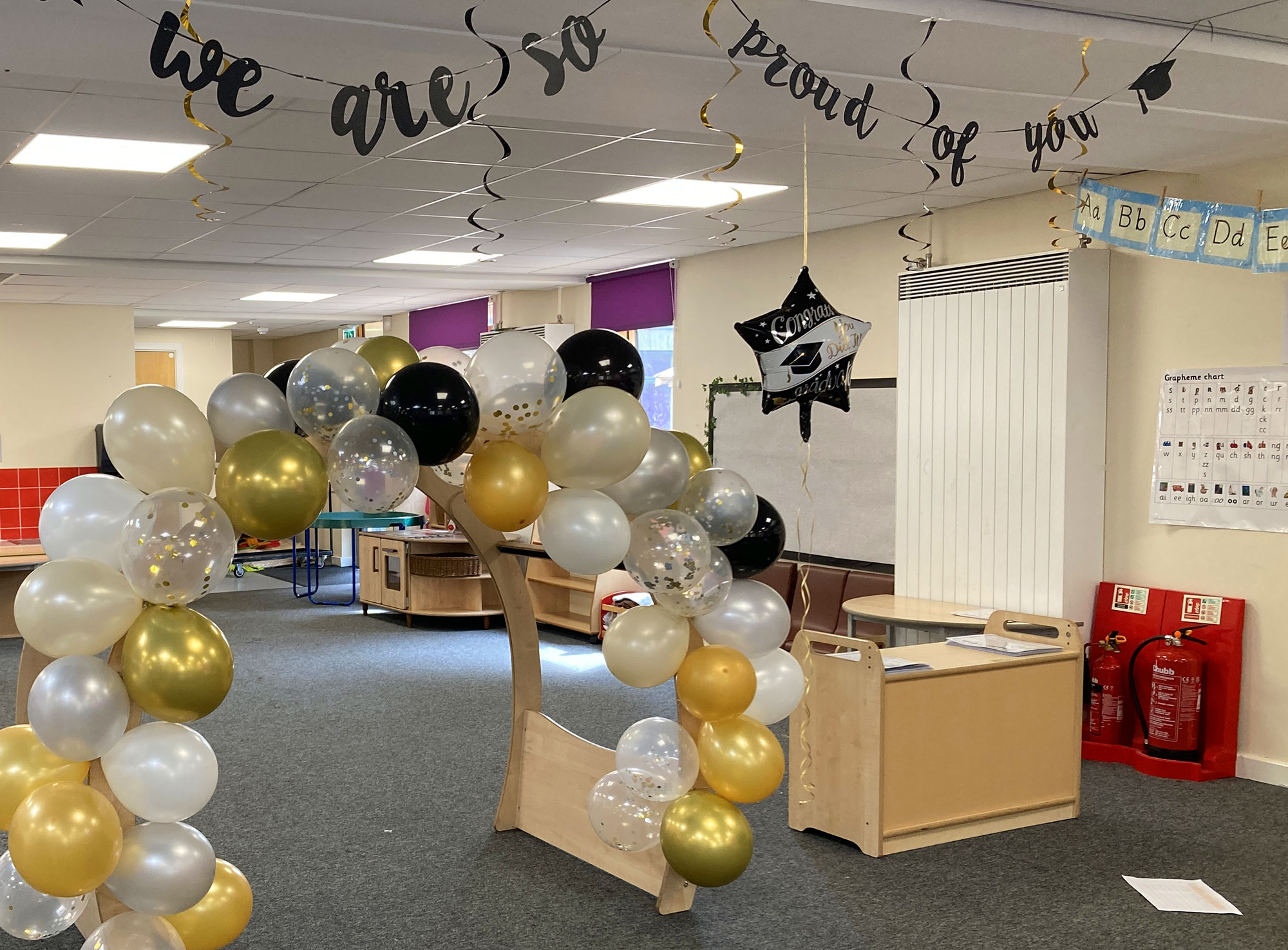
End of term celebration in a classroom at St. Stevens, with alphabet and grapheme charts displayed on the wall.
Takeaways from Teaching Reading in the United Kingdom
- Good relationships are key to successful schools. Paul could have stayed very busy with administrative work behind a closed office door. But he took the opposite approach: he spent a great deal of time walking around, having conversations and building relationships. His school hummed with positive energy despite its many challenges.
- English is decodable, readable, and teachable. The way English is written is complex, but still logical. When we teach from this perspective, we fuel ourselves and our students through the journey to literacy.
- Children all over the world are learning to read. This is a takeaway not only from the U.K., but all my school visits. It’s a tough job, and there are increasing obstacles to helping children build a literate life. But I’ve seen children learning to read in places near and far, and teachers doing the daily work to make that happen. When challenges arise, it’s encouraging to remember all the vastly different classrooms where children are discovering their writing systems. We can do it, too.
Resources
- Launa at Large(opens in a new window)
- Launa Hall’s Field Trip Notebook(opens in a new window)
- Reading Tips for Parents in English(opens in a new window)
- The Bell Ringer: Inside England’s Phonics Revolution
Additional posts from this series
About the Author
Publication Date
March 26, 2026