


I’ve always loved that legendary Jeopardy! champion James Holzhauer credited children’s nonfiction picture books for his massive success on the show. It’s a great testament to the fact that picture books are often simply the very best way to make information come alive!
And we need it to come alive, especially when it comes to people who are very nearly forgotten. Sandra Nickel is an award-winning author whose work includes picture book biographies that bring fascinating, often overlooked lives vividly to the page — the creator of nachos Ignacio Anaya in Nacho’s Nachos(opens in a new window), Tiffany lamp designer Clara Driscoll in Making Light Bloom(opens in a new window), astronomer Vera Rubin in The Stuff Between the Stars(opens in a new window), and meteorologist Joanne Simpson in Breaking Through the Clouds(opens in a new window).
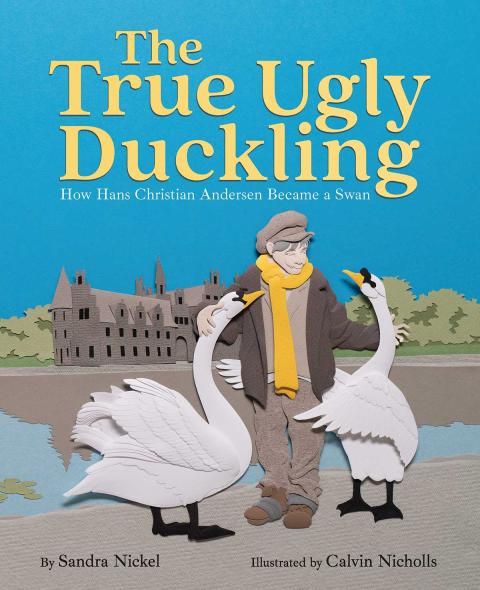
Her newest book, The True Ugly Duckling: How Hans Christian Andersen Became a Swan, takes on one of the world’s most beloved storytellers. Sandra tells his story in a way it has never been told before — through a lens that considers what scholars now know of his neurodiversity.
Structured like a fairy tale and illustrated by Calvin Nicholls with extraordinary cut-paper sculptures, this is a book as inventive as its subject and we’re delighted to have Sandra here to share more.
Scissors, Paper, Stories by Sandra Nickel

Hans Christian Andersen said the story of The Ugly Duckling was actually the story of his own life. When I read this, I immediately started looking into why he would say this. What in his life had happened so that he portrayed himself as a duckling who was rejected by everyone he met?
Reading through his autobiographies, it became abundantly clear why he had portrayed himself this way. Andersen had been alone, misunderstood, and bullied before growing up and becoming the famous writer we know as the Father of the Modern Fairytale. I tell of this in The True Ugly Duckling, How Hans Christian Andersen Became a Swan.
Andersen also found a way to comfort himself during his hard times. There are many descriptions about Andersen’s anxiety about life and fitting in. Cutting out shapes, first from cloth and later from paper, soothed him. And when he became immensely popular and was invited by kings and countesses to recite his stories in their castles — something that was nervous-making for Andersen—he continued using this coping technique.
As he stood in front of the noble guests and told his stories, he took a scissors and paper from his pocket and created a paper cutout at the same time. Since he had been practicing since he was a young child, his cutouts were intricate and beautiful. You can see for yourselves in this “fully cut fairy tale” from the Metropolitan Museum of Art’s website(opens in a new window).
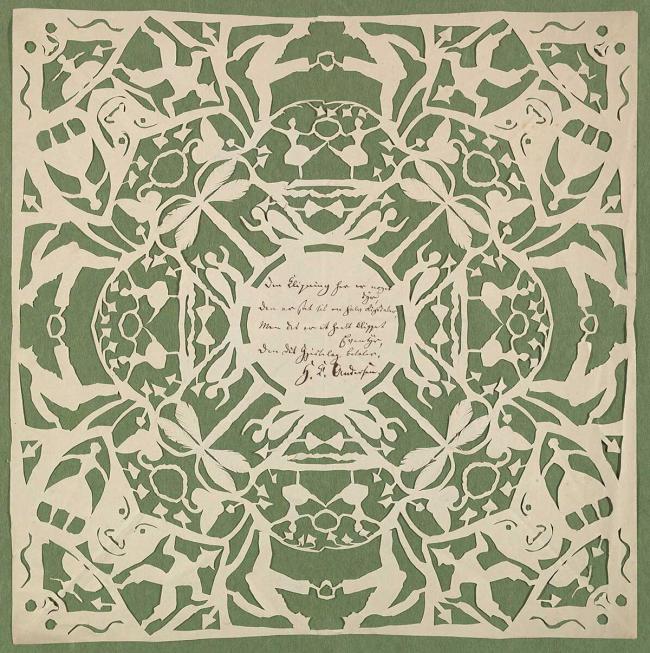
Because of the importance of paper cutouts to Andersen, Arthur Levine, the editor of The True Ugly Duckling, chose paper sculptor Calvin Nicholls to illustrate Andersen’s life. Nicholls used a different technique from Andersen’s and the result is absolutely stunning.

To connect kids with Hans Christian Andersen and his world of storytelling and paper art, try the activities below.
Biographies as fairytales
Start off by reading the biography, The True Ugly Duckling, How Hans Christian Andersen Became a Swan. It is told in fairytale form, as Andersen told his stories.
Now, ask, “If your life story was told as a fairytale, how would it go?” Would you be a duck, a frog, a nightingale, a swan? Or would you be someone else taken from one of Andersen’s other fairytales? A little mermaid or merman? A prince or princess with a pea? An emperor or empress with “new clothes”?
Then, for an added dimension, have kids cut out shapes from paper as they tell their life stories as fairytales.
Making paper cutouts
Andersen’s Technique
To try the half-makes-whole paper-cutting technique that is similar to the one Andersen used, gather a scissors and a sheet of paper. Fold the paper in quarters. Along the folded sides, draw half shapes — hearts, diamonds, butterflies, whatever you like. Cut out these half shapes, then unfold your paper and discover the whole you created!
Nicholl’s Technique
To try Calvin Nicholl’s sculpture technique, cut out the shapes that inspire you from different colored paper. For example, if you are paper sculpting a house, cut out walls from one color, windows from another, and the roof from another. (For inspiration, look at Nicholl’s illustration above.) After you’ve finished cutting your shapes, glue them on top of each other. Now, sit back and admire the paper sculpture you’ve created.
Wishing you all a wonderful time with fairy tales and paper cutouts!
Resources
- Sandra Nickel website(opens in a new window)
- Resources for The True Ugly Duckling(opens in a new window)
- Uniquely Human: The Podcast: EPISODE 156: Hans Christian Andersen: His Neurodivergent Journey as Shared by Autistic Children’s Author, Sandra Nickel(opens in a new window)
- Calvin Nicholls’ Remarkable Artistic Process(opens in a new window)
- Hans Christian Andersen: Poet with Pen and Scissors(opens in a new window)
- Start with a Book: We Are Storytellers: Exploring Multicultural Folktales, Fairy Tales, and Myths(opens in a new window)
- Favorite Books for Kids with Learning and Attention Issues