

Key Information
Focus
When To Use This Strategy
Appropriate Group Size
What are semantic gradients?
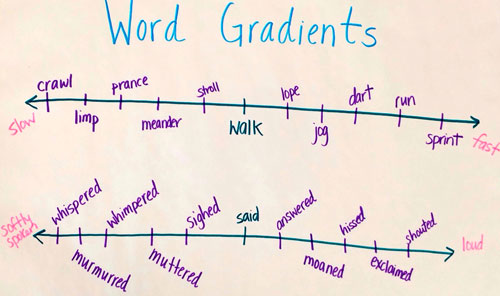
A semantic gradient is a list of related words placed on a continuum, gradually shifting meaning from one word to its antonym. A semantic gradient that is anchored at one end by the word microscopic and at the other end by the word gargantuan might have the words huge, miniature, small, and enormous somewhere in between. Putting words in order to create a semantic gradient can help students understand antonyms and also the subtle differences between similar words — shades of meaning — and can help expand their spoken and written vocabulary.
Why use semantic gradients?
- Helps broaden and deepen students’ understanding of related words
- Helps students recognize and distinguish between shades of meaning
- Enhances students’ vocabulary, which can help them be more precise and descriptive in their spoken and written language
- Helps develop students’ word-learning skills encourages curiosity about words
How to use semantic gradients
- Select a pair of polar opposite words to serve as your anchor words. Set up the gradient horizontally or vertically, leaving plenty of space in between the anchor words for adding words to the gradient. Make sure the students understand the anchor words.
- Generate (or have ready) at least five synonyms for each of the opposite words to add to the gradient.
- Model by thinking aloud as you decide where to place some of the words in between the anchor words.
- Continue to add words to the gradient with input from students. Arrange the words in a way that makes a bridge from one anchor word to the other. Move words up or down the gradient as needed to accommodate new words.
- Have students discuss their rationale for placing certain words in certain locations. Encourage a conversation about the subtle differences among the words.
OR
- Select a specific vocabulary word, e.g., large. Descriptive words (adjectives) tend to work best.
- Using a book you’ve read, a unit of study, or different writing samples, create a list of semantically related words. You can prepare a list in advance or work with students to generate a list. The brainstormed words will extend off either side of your target word, making the original word in the center of your continuum.
- Work with students to arrange the words in a way that illustrates an understanding of each word’s meaning.
- Have students discuss their rationale for where they place the words. Encourage a conversation about the subtle differences among the words.
Watch a lesson (whole class)
Go inside Cathy Doyle’s second grade classroom in Evanston, Illinois to observe how her students use this strategy to talk about the nuanced differences in the meaning of related words. A recent class read-aloud, A Seed Is Sleepy, is the springboard for a lively discussion about words that describe the relative size of things (for example, massive vs. gigantic, tiny vs. microscopic). Joanne Meier, our research director, introduces the strategy and describes how semantic gradients help kids become stronger readers and more descriptive writers.
Collect resources
Download this semantic gradients handout, with examples of topics or themes and words that relate to that topic.
Words from semantic gradients can be used for word analysis activities.
For more about vocabulary development, visit the Vocabulary Module of our Reading 101 Course
Differentiate instruction
for second language learners, students of varying reading skill, and for younger learners
- Depending on students’ skill level and familiarity with the words or concepts, have them work in small groups or pairs. Heterogenous r small groups or pairings may encourage conversation.
- It may be challenging for students to generate their own anchor word pairs. Having some word pairs on hand to provide to students can help them get started.
- Encourage students to develop their own list of words based on something they’ve recently read or learned about.
- If starting with a list of words, have English-learners look for cognates or translate some words into their first language to provide a point of reference.
- Incorporate visuals by referring to illustrations or photographs to help students understand words or by having students draw illustrations to represent words on the continuum.
Extend the learning
Language Arts
Download this semantic gradients handout(opens in a new window), with information about semantic gradients, a demonstration of the steps involved in creating the continuum of words, and examples of topics or themes and words that relate to that topic.
Science and Social Studies
Teachers in grades K-3 can see if there are word opposites that might lend themselves to creating a semantic gradient in science or social studies. Words related to size, texture, and temperature can work well with this strategy.
See the research that supports this strategy
Greenwood, S.C., & Flanigan, K. (2007, November). Overlapping Vocabulary and Comprehension: Context Clues Complement Semantic Gradients. The Reading Teacher, 61(3), 249-254.
Stahl, S.A., & Nagy, W.E. (2006). Teaching word meanings. Mahwah, NJ: Erlbaum.
Children’s books to use with this strategy

How Are You Peeling? Foods With Moods

Bring on the Birds

What Do You Do with a Tail Like This?

Lemons Are Not Red

Fancy Nancy’s Favorite Fancy Words: From Accessories to Zany
