

Key Information
Focus
Appropriate Group Size
What is persuasive writing?
Persuasive writing is a form of writing where the writer attempts to convince or persuade the audience to adopt a particular point of view or take a specific action by presenting logical reasoning, supporting evidence, and compelling arguments.
This type of writing encourages students to formulate a clear viewpoint on a particular topic, provide reasons to support their opinion, and convince their audience to adopt their perspective. Persuasive writing is an essential skill that helps students develop critical thinking, effective communication, and the ability to express themselves persuasively.
Why teach persuasive writing?
As children mature as writers, it’s important to give them the opportunity to write using a variety of formats. Persuasive writing helps students formulate specific reasons for their opinions, and provides an opportunity to research facts related to their opinions. As students develop an understanding of how writing can influence or change another’s thoughts or actions, they can begin to understand the persuasive nature of the marketing they are exposed to through television, the Internet, and other media.
How to teach persuasive writing
- Have students listen to or read examples of persuasive writing. Together, listen and look for words, phrases and techniques that helped the writer persuade the listener.
- Brainstorm something that is important to an individual child or the group. Is it extra recess? Another chapter of the read aloud? The potential closing of a library? The more authentic the issue, the more passionately your students will write.
- Once the important privilege is chosen, have the student (or class) start to list reasons why they should be allowed this privilege. “Just because,” and “because I like it” should not be considered valid reasons. Students can work together to generate at least three good reasons to support an argument. This list of persuasive words and phrases may help get students started.
- Have students do some research to gather facts or examples that support their reasons.
- Persuasive writing often involves considering the needs and perspectives of the target audience. Students learn to tailor their arguments to appeal to different readers.
- A well-crafted introduction is essential to capture the reader’s attention. It often includes a hook, background information on the topic, and a clear thesis statement expressing the writer’s opinion.
- Students may consider counterarguments or opposing views. This helps them anticipate and address potential objections to their opinion.
- Have students summarize their position. The conclusion summarizes the main points and restates the opinion in a compelling manner. It may also include a call to action or a thought-provoking statement.
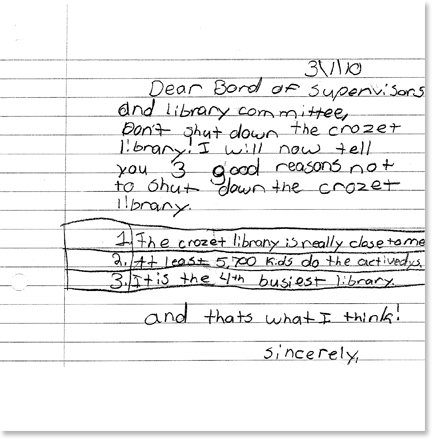
Here’s a persuasive letter written by an elementary school student from Crozet, VA:
Watch a lesson (whole class)
Create an authentic writing opportunity that motivates students to write persuasive letters to a target audience. In this example, students brainstorm ideas and then write convincing letters to the principal to try to get permission for a ‘Bubble Gum’ science project. (Balanced Literacy Diet: Putting Research into Practice in the Classroom)
Watch tips on teaching persuasive writing
These three tips will help your students write their opinions and share reasons to persuade their audience. (Susan Jones Teaching)
Collect resources
- Persuasive writing template
- This persuasive writing lesson(opens in a new window) from ReadWriteThink uses the Beverly Cleary book Emily’s Runaway Imagination as the springboard for kids to write letters to a librarian urging the addition of certain titles to the library. A Persuasion Map Planning Sheet guides students through steps similar to what is described above.
- This resource shows the steps for writing a persuasive letter(opens in a new window) to the student’s parents about where to vacation for the summer. The process begins with the brainstorming, moves through drafting, editing, and publishing of the final letter.
Differentiate instruction
For second language learners, students of varying reading skill, and younger learners
- Have students work in small groups to generate their ideas and do the research.
- Offer various suggestions for how students can share their argument: e.g., a debate format, a “soapbox” in the classroom, or letters to the editor of the newspaper.
See the research that supports this strategy
Wollman-Bonilla, J. (2000). Family message journals: Teaching writing through family involvement. Urbana, IL: National Council of Teachers of English.
Children’s books to use with this strategy

Martin’s Big Words: The Life of Dr. Martin Luther King, Jr.

Click, Clack, Moo: Cows That Type

The Storyteller’s Candle

How Oliver Olsen Changed the World

Otto Runs for President
