

Key Information
Focus
When To Use This Strategy
Appropriate Group Size
What is an inquiry chart?
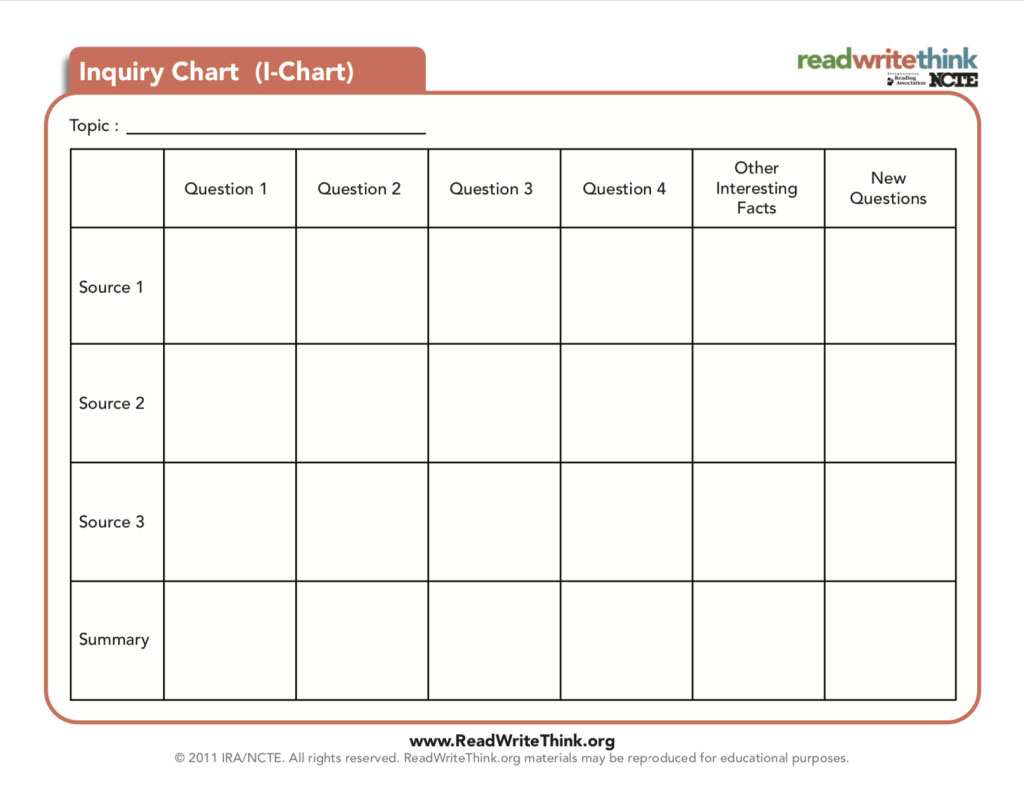
Inquiry charts — also called I-charts — are graphical “thinking maps.” They are powerful tools in helping students to organize information gathered during research or investigation activities. Students read or listen to several sources on the topic and record answers to the posed questions within the I-chart, and generate a summary in the final row. Different answers from various perspectives can be explored as a class.
Why use an inquiry chart?
- It fosters critical thinking and strengthens reading skills.
- It teaches younger students to generate meaningful questions about a topic and learn to organize their writing.
- Students build upon prior knowledge or thoughts about the topic by sharing interesting facts.
- It can be a low-stakes way to evaluate how much your students have learned about a topic.
How to use an inquiry chart
1. Planning phase
- Provide each student with a blank I-chart and assist with topic selection (or provide the pre-selected topic).
- Have students work in pairs or small groups.
- Have students begin forming questions about the topic. These questions are placed at the top of each individual column.
- Have students collect reading materials to learn more about the topic.
2. Interacting phase
- Ask students to think about what they already know about the topic and to record that in the first row of the I-chart.
- Have students read and pull key ideas from several different sources of information in order to fill in the other rows in the I-chart.
- Encourage your students to share interesting facts with their partners or within their small groups.
3. Integrating and evaluation phase
- Have students use the last row in their I-charts to pull together their ideas into a general summary.
- Students will use their summarizing, comparative analysis, critical thinking, and research and reporting skills as they resolve competing ideas found in separate sources or develop new questions to explore based on any conflicting or incomplete information.
- You can invite partners or small groups present what they have learned to the whole class.
Watch a lesson: inquiry-based learning
Wildwood IB World Magnet School uses the inquiry-based model to put students in charge of their learning, with lessons that stem from student questions and harness the power of curiosity. (Edutopia)
Collect resources
Download blank templates
Sample I-chart
Science
The example below is an inquiry chart that students could use to reveal what they learn about simple machines. See example ›
Differentiate instruction
For second language learners, students of varying reading skill, and younger learners
- Keep the questions simple for younger students.
- Pre-fill parts of the I-chart organizer for students that need the support.
Extend the learning
- Encourage students to continue to add new questions as they learn more, so they can dive deeper into a topic.
- Have students use their information to create a product (e.g., research paper, brochure, or PowerPoint presentation).
- Try the I-chart strategy in other subject areas where the students are engaged in research.
Science
The example below is an inquiry chart that students could use to reveal what they learn about simple machines. See example ›
See the research that supports this strategy
Hoffman, J. (1992). Critical reading/thinking across the curriculum: Using I-charts to support learning. Language Arts, 69(2), p. 121-27.
Jones, R. (2006). Strategies for Reading Comprehension: Inquiry Chart.
FOR-PD. (2006). FOR-PD’s Reading Strategy of the Month.
Children’s books to use with this strategy

Lincoln and His Boys

Mr. Lincoln’s Boys
