

Key Information
Focus
Appropriate Group Size
What are Elkonin boxes?
Elkonin boxes, also known as sound boxes, help emerging readers build phonological awareness skills by segmenting words into individual sounds (phonemes). When working with words, the teacher can draw one box for each sound in a target word. Children push a token into one box as they say each sound in the word. Elkonin boxes can also be used in phonics instruction to support phoneme-grapheme mapping (the alphabetic principle).
Why use Elkonin boxes?
- They help students build phonological awareness by segmenting words into sounds or syllables.
- They teach students how to count the number of phonemes in the word (not always the number of letters).
- They help students better understand the alphabetic principle in decoding and spelling.
How to use Elkonin boxes
- Pronounce a target word slowly, stretching it out by sound.
- Ask the child to repeat the word.
- Draw boxes or squares on a piece of paper, chalkboard, or dry erase board with one box for each syllable or phoneme.
- Have the child count the number of phonemes in the word, not necessarily the number of letters. For example, wish has three phonemes and will use three boxes. /w/, /i/, /sh/
- Direct the child to slide one colored circle, Unifix cube, or corresponding letter in each cell of the Elkonin box drawing as he/she repeats the word.
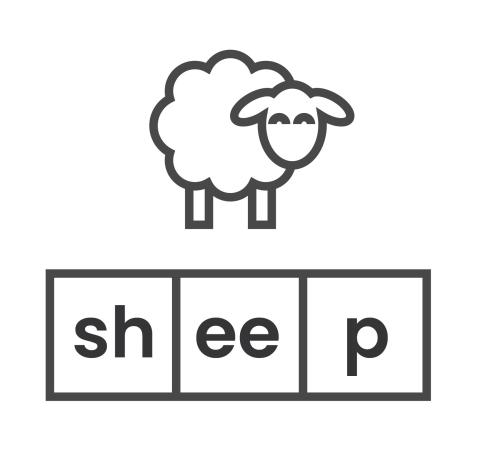
The example below shows an Elkonin box for the word sheep, which consists of three phonemes (sounds): /sh/ /ee/ /p/
Extension: pairing with print
Although Elkonin boxes are mostly used with spoken words, you can increase the intensity of the lesson by asking children to write the letters for each sound in the boxes after segmenting orally.
Do steps 1-5 above but ask the child to pick up a pen and write the grapheme/s (letter/s) in each box. Each box holds one sound. This extension allows children to match the letters to the sounds in each word. A child can write the letters in the boxes OR use letter tiles.
For sounds spelled with more than one letter, write all the letters for that sound in a box.
Examples
Write the letter for each spoken sound in the word in each box.


Silent letters or vowel teams can be written together in a single box.

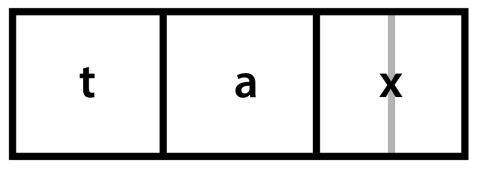
Letters like ‘x’ in that make two sounds (/k/ and /s/) can straddle two boxes.
Watch a lesson (small group)
A first grade teacher demonstrates the use of Elkonin sound boxes and talks about how this research-based strategy helps build phonemic awareness skills. (Understood)
Watch a lesson (small group)
Watch this teacher help two children strengthen their phonemic awareness skills by practicing with Elkonin sound boxes. (Rollins Center for Language and Literacy)
Watch a lesson with letters (small group)
Watch this one-on-one demonstration of how Elkonin boxes can be used to promote phonemic awareness, as well as encoding and decoding skills. (University of Florida Literacy Institute)
Collect resources
- Using Elkonin Sound Boxes
- Phonics Intervention Strategy: Sound (Elkonin) Boxes
- This website offers teachers several Elkonin box templates for various target words. Elkonin box word templates ›(opens in a new window)
- Teachers may wish to use the blank templates found on this website to accompany a segmenting task and provide students the opportunity to practice writing. Students can write each sound represented in the target word and then write a short sentence using the word. Elkonin box and writing template ›
Differentiate instruction
For second language learners, students of varying reading skill, and younger learners
- Ideas for using Elkonin boxes with Spanish speaking students.
- Have more advanced students write letters in the boxes as you dictate words.
- Use this strategy in the following ways to meet each student’s individualized reading level:
- Words with pictures and only two boxes
- Words with pictures and three boxes
- Words with no pictures and up to four boxes
See the research that supports this strategy
Blachman, B. A., Ball, E. W., Black, R., & Tangel, D. M. (2000). Road to the code: A phonological awareness program for young children. Baltimore: Brookes.
National Institute of Child Health and Human Development. (2000). Report of the National Reading Panel. Teaching children to read: An evidence-based assessment of the scientific research literature on reading and its implications for reading instruction (NIH Publication No. 00-4769). Washington, DC: U.S. Government Printing Office.
Children’s books to use with this strategy

Go, Dog, Go!

Runny Babbit: A Billy Sook

Hamsters, Shells, and Spelling Bees: School Poems
