

Key Information
Focus
When To Use This Strategy
Appropriate Group Size
What is a concept map?
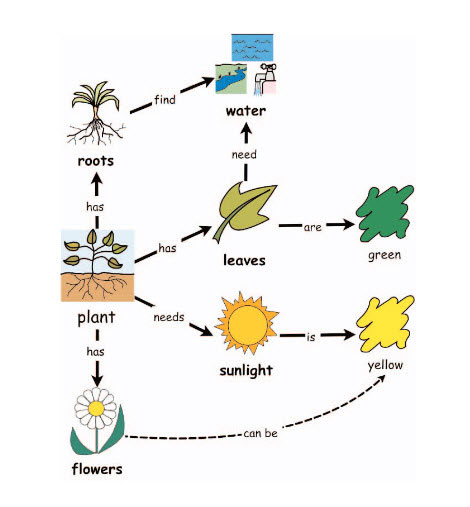
A concept map is a visual organizer that can enrich students’ understanding of a new concept. Using a graphic organizer, students think about the concept in several ways. Most concept map organizers engage students in answering questions such as, “What is it? What is it like? What are some examples?” Concept maps deepen understanding and comprehension.
Why use a concept map?
- It helps children organize new information.
- It helps students to make meaningful connections between the main idea and other information.
- They’re easy to construct and can be used within any content area.
How to use a concept map
Note: It is important to spend time introducing younger students to charts and diagrams prior to using this strategy.
There are several ways to construct concept maps. Most include the following steps:
- Model how to identify the major ideas or concepts presented in a selection of text as you read.
- Organize the ideas into categories. Remind your students that their organization may change as they continue to read and add more information.
- Use lines or arrows on the map to represent how ideas are connected to one another, a particular category, and/or the main concept. Limit the amount of information on the map to avoid frustration.
- After your students have finished the map, encourage them to share and reflect on how they each made the connections between concepts.
- Encourage your students to use the concept map to summarize what was read.
Watch a lesson (whole class)
Watch primary students using an Interactive word wall with words related to the unit of study (both domain specific and academic vocabulary). Students manipulate the words as they discuss relationships among the words and ideas. There are many ways to use an interactive word wall; this video shows students doing concept mapping. (EL Education)
Watch a classroom demonstration
Mind maps are a unique way for students to build their knowledge of a topic and display new and interesting vocabulary. (Balanced Literacy Diet: Putting Research into Practice in the Classroom)
Collect resources
Download blank templates
Differentiate instruction
For second language learners, students of varying reading skill, and younger learners
- You can use concept maps as a pre-reading strategy by inviting students to share what they already know about a particular concept. While reading, ask students to help add to the map as a group using an overhead or large chart. This provides a visual aid for building upon their prior knowledge with new information they have gathered from reading.
- You may wish to have your students practice writing skills by asking them to write on their own concept map.
- Teach vocabulary words explicitly and use simple words.
- Be sure the pointed part of each arrow is clear. Design the graphics to minimize directional confusion.
- When applicable, allow your students to draw pictures or use cut out pictures as well as words.
- Allow the number of concepts represented in each student’s mural to differ based on their abilities or interests.
- Choose content area texts that reflect diversity.
Use across the content areas
Science
- See how a concept map could be used with a topic such as the study of weather. See example ›
- Here’s a more complex concept map from a study on bats. See example ›
- See how concept maps have been usedto help students understand more about trees, their bodies, and other familiar topics. See example ›
- Here’s a step-by-step on building concept maps for a variety of topics: plants, football, and the Cinderella fairytale. See example ›
See the research that supports this strategy
Birbili, M. (2007). Mapping Knowledge: Concept Maps in Early Childhood Education . Retrieved November 4, 2008.
Council for Exceptional Children, the Division for Learning Disabilities (DLD) and the Division for Research (DR). Graphic Organizers: Power Tools for Teaching Students with Learning Disabilities .
Farris, P. & Downey, P. (2004). Concept muraling: Dropping visual crumbs along the instructional trail. The Reading Teacher, 58, 376-380.
Hyerle, D. (1996). Visual tools for constructing knowledge. Alexandria, VA: Association of Supervisors of Curriculum Development.
Novak, Joseph D. (1998). Learning, creating, and using knowledge: Concept maps as facilitative tools in schools and corporations. Mahwah, NJ: Erlbaum.
Noyd, Robert. (1998). A primer on concept maps. USAFA Educator, 7(1).
Schroeder, N.L., Nesbit, J.C., Anguiano, C.J. et al. Studying and Constructing Concept Maps: a Meta-Analysis. Educational Psychology Review 30, 431–455 (2018). https://doi.org/10.1007/s10648-017-9403-9
Children’s books to use with this strategy

Me on the Map

Mapping Penny’s World
