

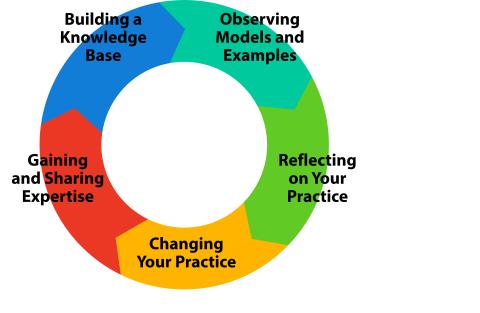
The North Central Regional Educational Laboratory has developed a research-based professional development framework that promotes ongoing professional development and encourages individual reflection and group inquiry into teachers’ practice. In practice, the five phases overlap, repeat, and often occur simultaneously:
1. Building a knowledge base
The purpose of this phase is to acquire new knowledge and information and to build a conceptual understanding of it. Activities in this phase might include goal setting, assessing needs, participating in interactive workshops, and forming a study group.
2. Observing models and examples
The purpose of this phase is to study instructional examples in order to develop a practical understanding of the research. In this phase, one might participate in activities such as school and classroom visitations, peer observation, using instructional artifacts, co-planning, and listening to or watching audio and video examples.
3. Reflecting on your practice
The purpose of this phase is to analyze your instructional practice on the basis of new knowledge. Activities in this phase might include the use of journals or teacher-authored cases for collegial discussion and reflection.
4. Changing your practice
The purpose of this phase is to translate your new knowledge into individual and collaborative plans and actions for curricular and instructional change. Activities might include action research, peer-coaching, support groups, and curriculum development.
5. Gaining and sharing expertise
The purpose of this phase is to continue to refine your instructional practice, learning with and from colleagues while also sharing your practical wisdom with your peers. Activities in this phase might include team planning, mentoring or partnering with a colleague, and participating in a network.
Citation
Used with permission of Learning Point Associates. The North Central Regional Educational Laboratory.
Reprints
You are welcome to print copies for non-commercial use, or a limited number for educational purposes, as long as credit is given to Reading Rockets and the author(s). For commercial use, please contact the author or publisher listed.